

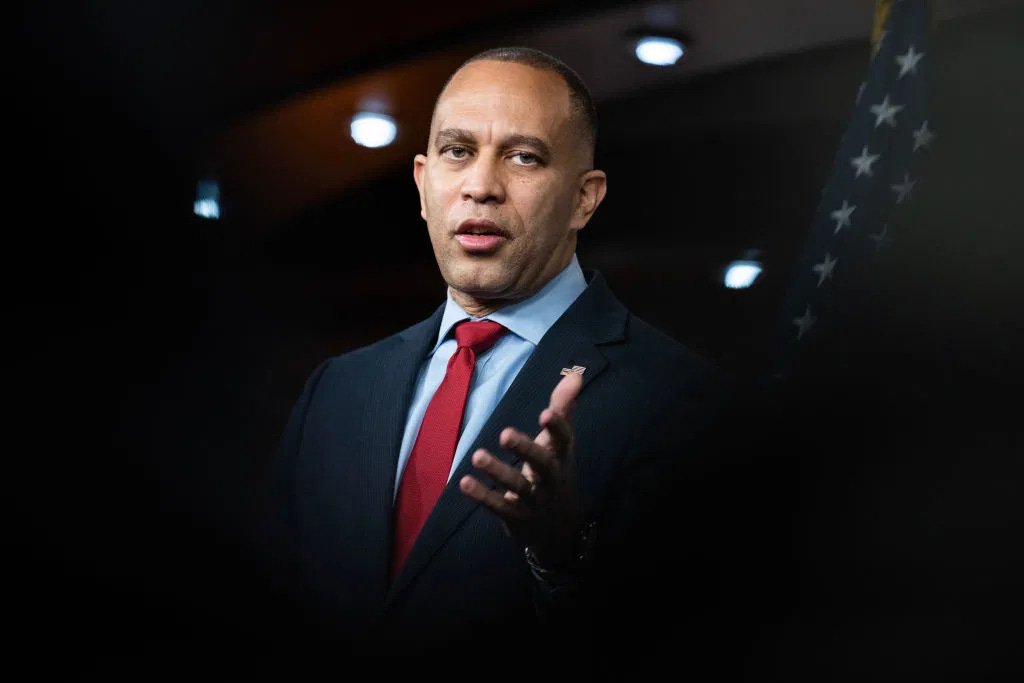
In just six weeks since Donald Trump’s return to the White House, he and his loyalist-packed administration have taken aggressive action in their dismantling of the federal government. At a moment when Democrats should be mounting a relentless, unified opposition, House Minority Leader Hakeem Jeffries has failed to rise to the occasion—leaving a power vacuum within the party.
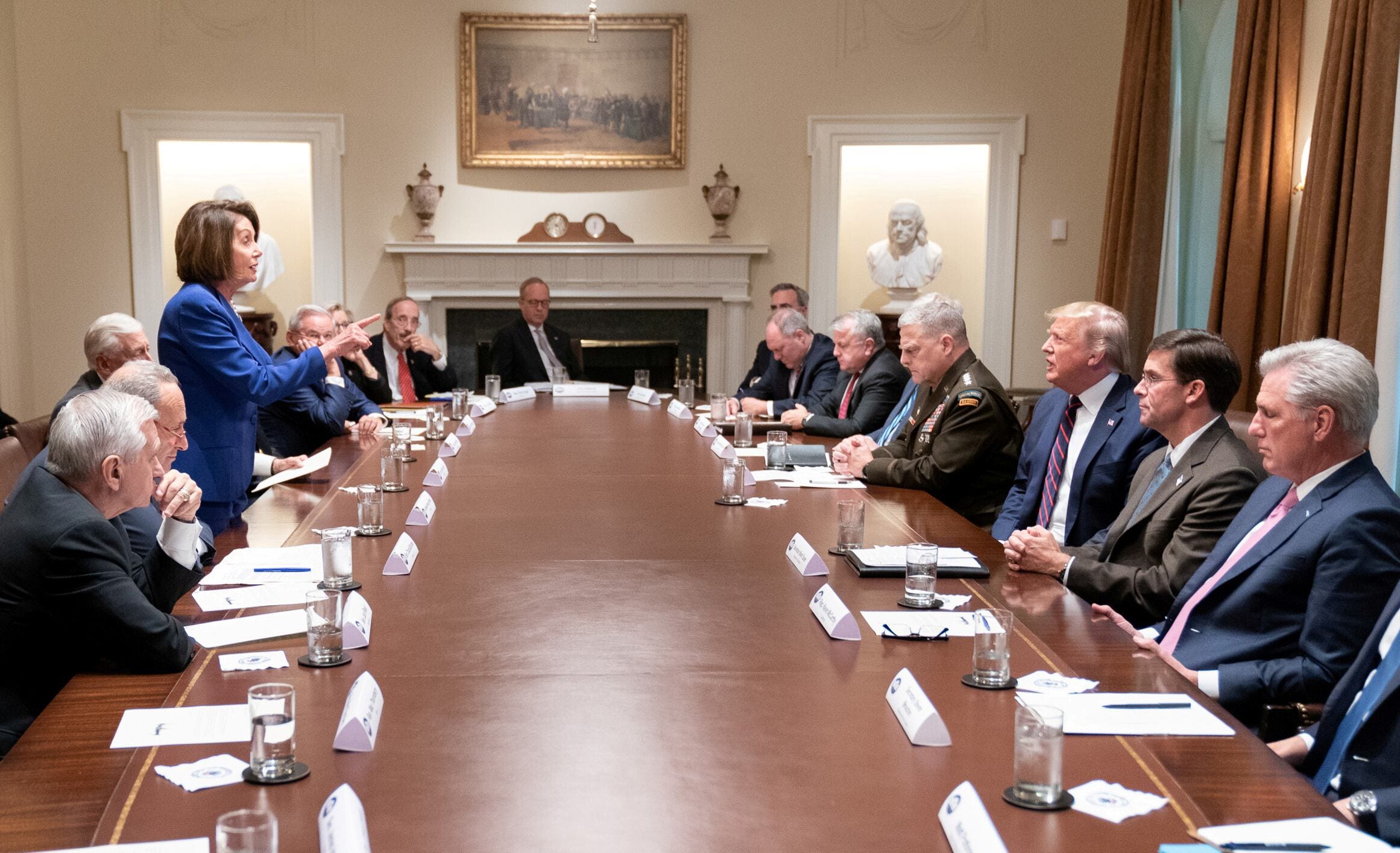
In 2017, the Democratic Party has a strong opposition leader to Trump in former Speaker of the House and then-House Minority Leader, Nancy Pelosi. With nearly 30 years of experience in the House, Pelosi was seen as someone with the strength and will to stand up to Trump, and lead the Democrats to retaking the majority in the 2018 midterm elections.
Republicans Are Waging War on the Federal Government
Trump’s second term has already proven to be a full-fledged attack on institutions. From executive orders slashing regulations, agency heads being replaced with far-right ideologues with no real qualifications, all while GOP lawmakers stand by watching it all happen. They’ve made it clear: their goal isn’t just to win elections—it’s to dismantle the federal government as we know it.
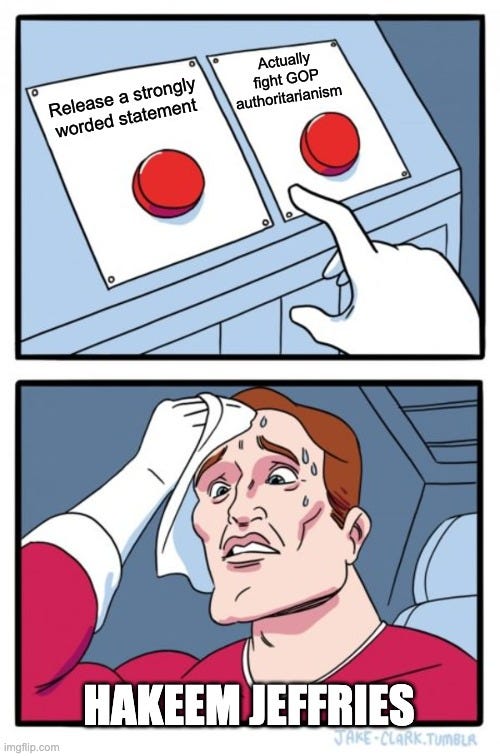
And yet, where is the forceful opposition from House Democrats? Where is the strategy to counteract GOP destruction? Instead of leading the charge, Hakeem Jeffries has largely remained reactive, offering the typical statements of condemnation and muted criticism, while failing to rally the Democratic base in a way that matches the urgency of this crisis.
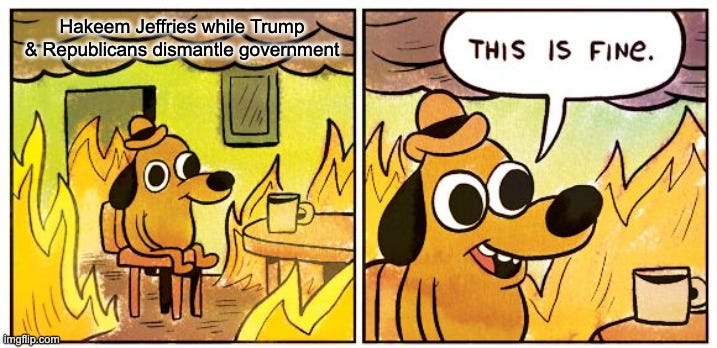
The House of Representatives was designed to be the chamber most responsive to the will of the people. With members facing re-election every two years, the House reflects the nation’s shifting political moods more immediately than the Senate, where longer terms and institutional traditions encourage deliberation and compromise. Unlike the Senate, which was intended to act as a moderating force, the House is where majoritarian power is meant to be exercised forcefully.
Throughout history, strong House leadership has played a crucial role in advancing ambitious party agendas—like Newt Gingrich’s “Contract with America” in the 1990s and Nancy Pelosi’s passage of the Affordable Care Act in 2010.
When Democrats hold the minority, their leader’s job is to rally the caucus, sharpen the contrast with Republicans, and keep the base engaged for future elections. Hakeem Jeffries, however, has failed to wield the House’s inherent partisanship as a weapon against Republican destruction, opting instead for a lackluster, defensive approach.
While the GOP floods the media with soundbites and viral moments that shape public perception, Jeffries has failed to command the national conversation. Republicans have dominated narratives on spending, immigration, and so-called “deep state” conspiracies, while Democrats struggle to deliver a counter-message that resonates with voters.
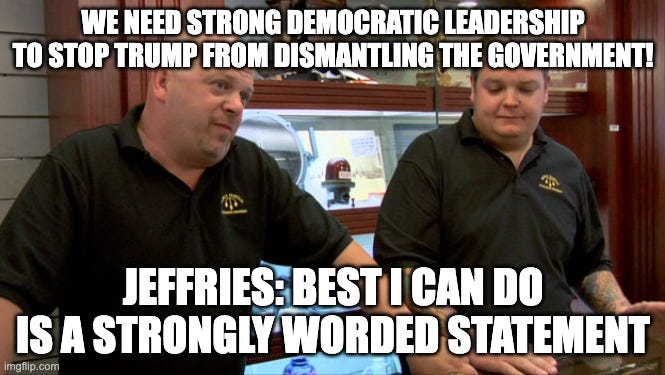
Even in the minority, House Democrats should be proposing an ambitious alternative to the Republican agenda. Instead, Jeffries has failed to articulate a clear economic populist and progressive legislative vision. There is no Democratic equivalent to the GOP’s push for tax cuts, deregulation, and privatization. There is no bold policy roadmap for voters to rally behind.
By contrast, past Democratic leaders—such as Nancy Pelosi—used their platforms to drive the party’s agenda, even in the minority. Jeffries, however, has not taken advantage of his role to set the direction for the future.
The Consequences of Weak Leadership
Jeffries’ failure to step into the role of a true opposition leader is not just a missed opportunity—it’s a crisis for the Democratic Party. Without strong leadership in the House, the party risks:
A demoralized Democratic base – Without a clear, forceful opposition, voters become disengaged, sapping the energy and urgency needed for victory in 2026 and beyond. A weak Democratic response to GOP extremism fuels disillusionment, especially among young and progressive voters who crave bold action.
A fractured party – In the absence of decisive leadership, progressive lawmakers are left to fight the battles Jeffries won’t, often without the institutional support they need. This division weakens the party’s ability to present a unified front against Republican authoritarianism.
An unchallenged Republican narrative – The GOP’s relentless messaging machine frames every debate, from immigration to government spending, while Jeffries fails to counter it with an equally aggressive Democratic alternative. When Democrats allow Republicans to dominate the conversation, they concede the battleground of public opinion.
A missed opportunity to reshape Democratic strategy – With Trump’s return, the Democratic Party faces a defining moment. It can either sharpen its identity as the defender of democracy and working people or continue muddling through with reactive, uninspiring leadership. Right now, it’s failing to seize that opportunity.
What Democrats Must Do Now
The stakes are too high for passive leadership. If Jeffries cannot meet the demands of this moment, then Democrats must look elsewhere for leadership that will. To effectively counter the Republican assault on democracy, the party should:
Embrace a clear, bold economic message – Democrats must champion policies that directly improve the lives of working- and middle-class Americans, from stronger labor protections to universal healthcare. Generic opposition to Republican policies isn’t enough—Democrats need an affirmative vision that excites voters.
Adopt an aggressive media strategy – The party must stop treating the mainstream media as a neutral arbiter and instead build an unapologetic, disciplined messaging operation. This means calling out GOP propaganda in real-time, flooding social media with viral content, and ensuring that every Democrat stays on message.
Mobilize grassroots energy – Democrats win when they engage their base, not when they cater to an imaginary center. The party must invest in grassroots organizing, digital activism, and local outreach to build sustained voter enthusiasm.
Stop playing by outdated rules – While Republicans openly dismantle democracy, Democrats cannot afford to cling to outdated norms of bipartisanship and institutional deference. The party must act with the urgency the moment demands, using every procedural tool, media platform, and political weapon at its disposal to fight back.
Jeffries time to prove himself as a leader is running out—if he refuses to step up, Democrats must start looking for someone who will. The survival of democracy may depend on it.