

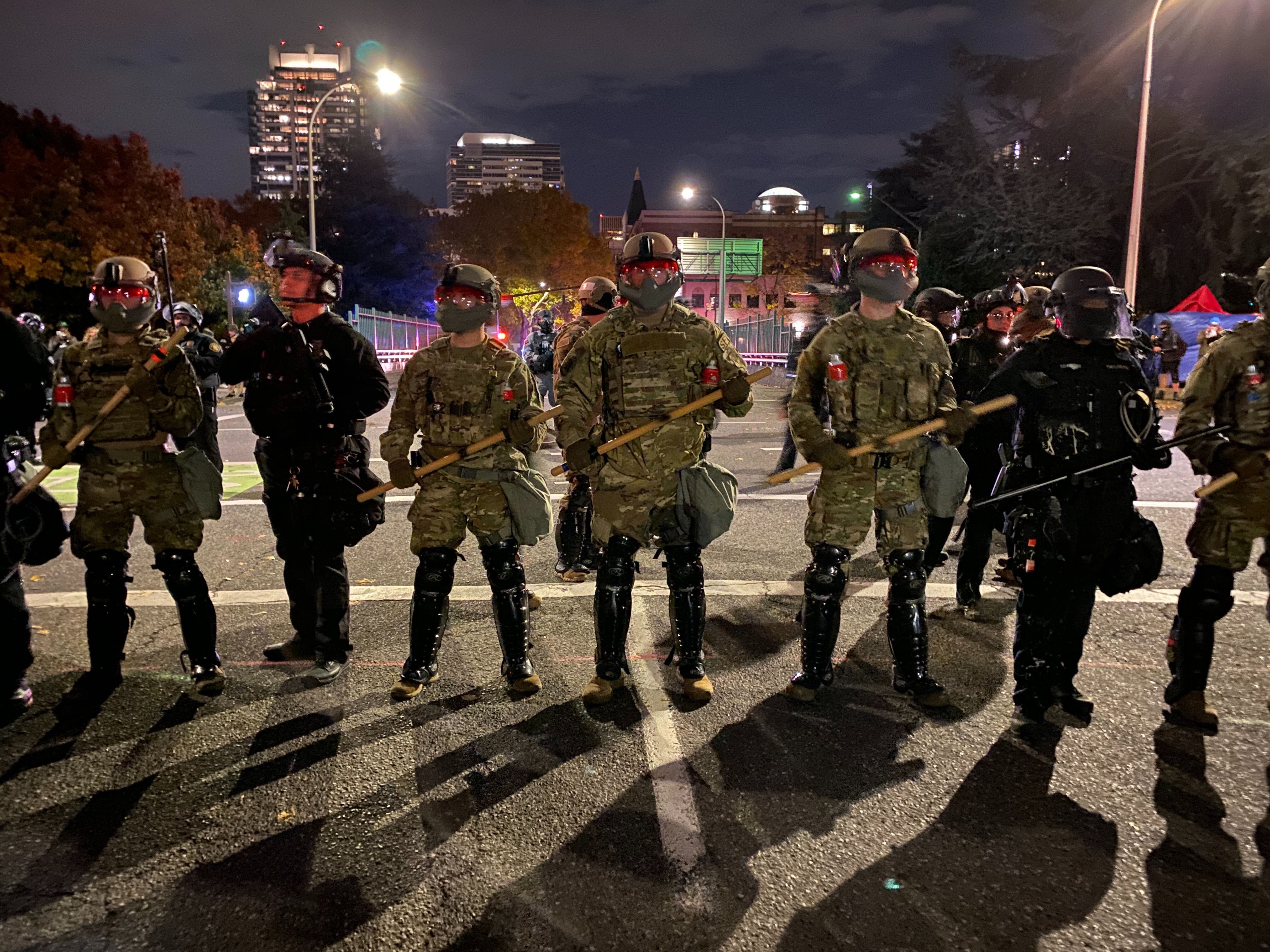
On September 27, the President of the United States posted a message on Truth Social announcing that he had authorized the deployment of troops and directed the Secretary of Defense to use “Full Force, if necessary” against “Antifa and other domestic terrorists” allegedly threatening ICE facilities in Portland, Oregon.
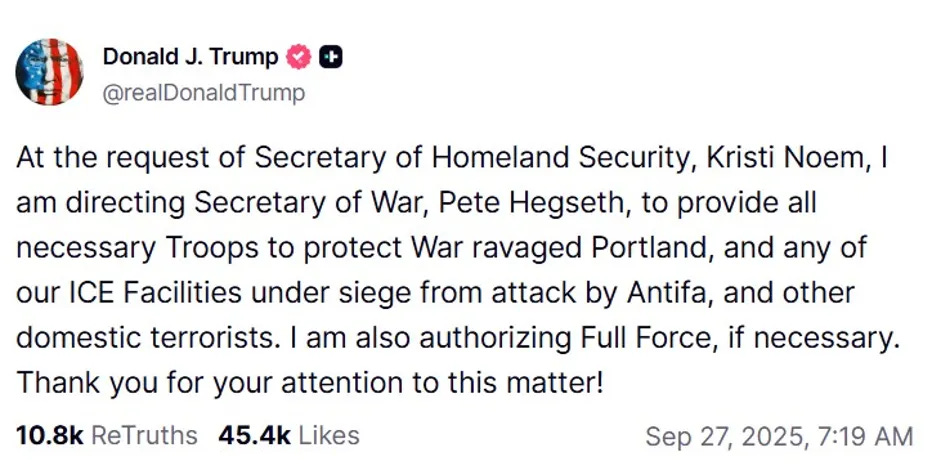
The deployment came over the objection of both state and local law enforcement and political leaders—clearly, this wasn’t a response to chaos. It was an invitation to it.
In fact, the protests outside of ICE facilities had shrunk to less than twenty people at the time of his order. Local police are trained in civil unrest and crowd control. They had the situation under control, and there was no imminent danger.
Let me be clear: the deployment of Oregon’s National Guard was not about peacekeeping. It’s part of a broader strategy to provoke unrest, delegitimize Democratic leadership, and manufacture a justification for even greater federal force.
Oregon’s Attorney General Dan Rayfield, along with the City of Portland, filed a lawsuit to prevent Trump’s illegal and unjustified deployment of federalized National Guard troops—arguing it violated constitutional limits, federal law, and the state’s sovereign authority.
U.S. Attorneys failed to persuade the Court that it lacked authority to second-guess the President’s determination that conditions in Portland warranted a federal military response.
And on Friday, a Trump-appointed judge issued a Temporary Restraining Order preventing the Oregon National Guard from being activated and deployed to Portland.
In addition to the expected statutory citations, the Court’s order invoked a deeper constitutional tradition. As the judge wrote, “this is a nation of Constitutional law, not martial law.” Accepting the Defendants’ arguments, the Court warned, would “risk blurring the line between civil and military federal power—to the detriment of this nation.”
Today, that same federal judge broadened the restraining order after Trump attempted to circumvent the court’s ruling by authorizing the deployment of National Guard troops from the states of California and Texas into Oregon.
The expanded order explicitly bars the federal government from using any state’s Guard units to carry out domestic law enforcement functions within Oregon without that state’s consent or lawful congressional authorization.
This latest action underscores that what’s unfolding is not merely a local dispute over policing—it’s a national test of constitutional boundaries. The administration’s defiance of the initial order reveals a deeper pattern of political theater masquerading as law enforcement, one that treats constitutional limits as obstacles rather than obligations.
At its core, this is a confrontation over who holds authority in our federal system: the states, or a president willing to bypass them. It’s about whether the rule of law still constrains executive power when that power is wielded for political spectacle rather than public safety.
What’s happening in Portland isn’t just a legal fight over troop deployments. It’s a stress test for American democracy.
When a president defies governors, sidesteps courts, and uses military force to stage political theater, the danger isn’t just in the spectacle—it’s in the precedent. If this tactic succeeds, it won’t stop at Portland. It will become a blueprint for future executive overreach, where dissent is reframed as disorder and federal power is deployed not to protect, but to punish.
Judge Immergut’s order is more than a legal barrier—it’s a civic alarm. It reminds us that state sovereignty, civilian control of the military, and judicial independence are not optional features of our democracy. They are the scaffolding that holds it up.
And right now, that scaffolding is under immense strain.
We must call this what it is: weakness masquerading as strength, chaos engineered for control, and a dangerous attempt to turn federal force into a partisan weapon.
Judge blocks Trump’s National Guard deployment in Portland for second time
Judge temporarily blocks Trump administration from deploying National Guard in Portland