

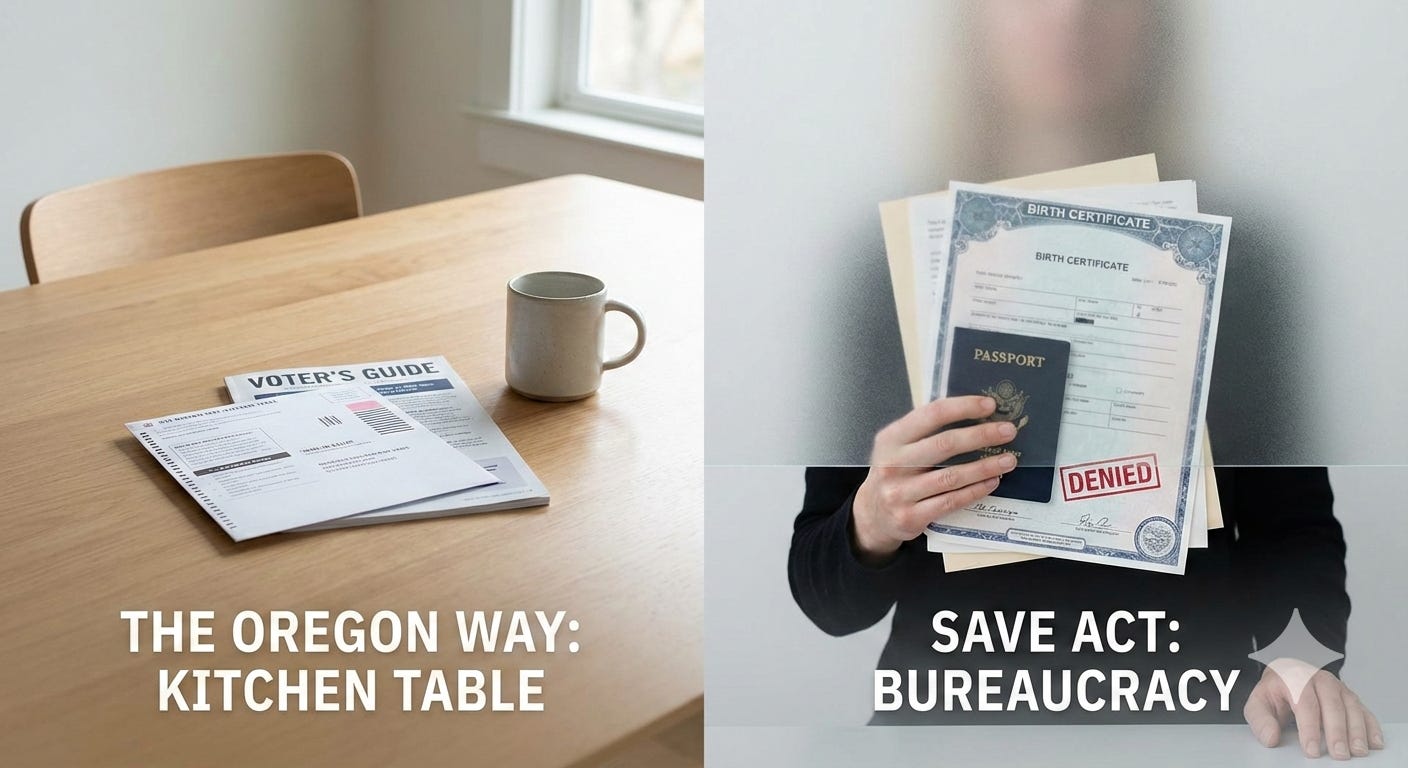
I grew up in a state where “Election Day” wasn’t a frantic dash to a polling place. It was a Tuesday evening at the kitchen table, followed by a short drive to the town’s ballot drop box before 8 p.m. In Oregon, I have never seen a voting booth in my life. I was automatically registered the day I got my driver’s license, and my ballot arrived in the mail like any other piece of critical correspondence. Critics call this system an “invitation to fraud,” but both the math—and my experience—tell a different story.
For more than a decade, Donald Trump has cast doubt on the accuracy and legitimacy of American elections. In 2020, he declared that “the only way we’re going to lose this election is if the election is rigged,” then alleged “widespread” fraud before votes were fully counted. That narrative collapsed under scrutiny, including from the Cybersecurity and Infrastructure Security Agency in his own administration, which concluded the election was “the most secure in American history” and found no evidence of compromised voting systems.
That gap between rhetoric and reality has now hardened into policy with the 2026 push for the SAVE America Act. Its supporters frame it as “common sense” election security. In practice, it embodies a Security Paradox: by erecting new walls of paperwork at the registration desk, we aren’t catching “ghost” voters—we are obstructing real ones. In Oregon, the system worked precisely because it was invisible. The state verified my eligibility using its own records before my ballot ever left the warehouse. The SAVE Act flips that logic, demanding that tens of millions of married women and low-income citizens prove facts the government already knows.
The Kitchen Table Advantage
In Oregon, voting wasn’t a rushed exercise in recall inside a cramped booth. It unfolded over days. When a ballot arrives at your kitchen table, democracy grants its rarest resource: time.
That time matters. Modern ballots are dense. In 2024, Maricopa County voters faced dozens of judicial races and complex constitutional amendments. In a polling booth, down-ballot contests are often skipped or guessed. At home, the election becomes open book. You can review judicial performance evaluations, read competing arguments on tax measures, and return to the ballot when you’re ready.
Research from the MIT Election Lab consistently shows that voters using mail or at-home ballots are more likely to complete their entire ballot, reducing roll-off in local races. That isn’t a procedural detail; it’s democratic engagement. A system that values speed over comprehension produces participation without consent.
The SAVE Act undermines this entirely. By forcing voters back into in-person bureaucracy and documentation hurdles, it shrinks the mental space required to be the “informed electorate” we claim to value. Integrity isn’t only about verifying identity—it’s about respecting the weight of the choice being made.
Why the “Big Dump” Doesn’t Work
Claims of mass ballot dumping collapse under basic scrutiny.
To inject thousands of fraudulent ballots into an election would require a coordinated network: drivers, poll workers, election administrators, and technical staff all acting in concert. Political science tells us that as conspiracies grow, the likelihood of exposure grows faster. A secret shared by a handful of people might hold. One shared by hundreds becomes inevitable evidence.
Even then, invented votes leave fingerprints. Election results follow predictable statistical patterns. Large-scale fabrication produces anomalies—unnatural ratios, irregular margins—that stand out immediately in forensic analysis. Independent audits of recent elections examined these indicators repeatedly and found distributions consistent with real, organic voting behavior.
There is also the paper barrier. Even a perfectly forged ballot must correspond to a real, registered voter and pass signature verification. Many states, including Arizona, conduct post-election hand audits comparing paper ballots to machine tallies. Illicit ballots without a matching record don’t disappear quietly—they surface instantly.
Finally, there is deterrence. A coordinated effort to manipulate a national election isn’t petty fraud; it triggers federal conspiracy and racketeering statutes. The penalties are measured in decades of prison time and total organizational collapse. The idea that such a scheme could remain hidden—and be worth the cost—requires believing election officials are both morally corrupt and mathematically flawless. They are neither.
The Incentive Paradox
The SAVE Act also ignores the most basic logic of human behavior.
Casting a single fraudulent vote carries severe criminal penalties. The reward is infinitesimal: a one-in-hundreds-of-millions chance of influencing a presidential election. No rational actor trades their freedom for a statistical rounding error.
When legal voting is accessible, the incentive to cheat collapses. Fraud becomes irrational, not tempting. Front-end barriers like original birth certificates don’t deter criminals; they deter students, working parents, and low-income citizens who lack time, documentation, or flexibility. The policy doesn’t harden the system—it narrows participation.
Beyond the Mailbox
Mail voting is often mischaracterized as unsupervised. In reality, much of it bypasses the mail entirely. In recent elections, a significant share of early ballots were returned to secure drop boxes—steel vaults anchored in concrete, monitored continuously.
In Maricopa County, ballots are retrieved by bipartisan teams, logged, tracked, and transported under a strict chain of custody. From the moment a ballot leaves a voter’s hand, it is accounted for. This is not casual security; it is operational security.
What made Oregon’s system resilient wasn’t fear or friction. It was design. Eligibility was verified quietly, ballots were tracked obsessively, and voters were trusted with time and space to decide. That model doesn’t dramatize fraud—but it makes fraud pointless.
At my kitchen table, no one asked me to prove myself again. The system already knew who I was. The only thing left was the decision.
Aden’s Analysis is a Substack focused on politics, public policy, democracy, and the ideas shaping America’s future. I write for readers who want serious analysis without performative outrage — and who believe persuasion still matters.
Subscribe to receive new posts directly in your inbox.