

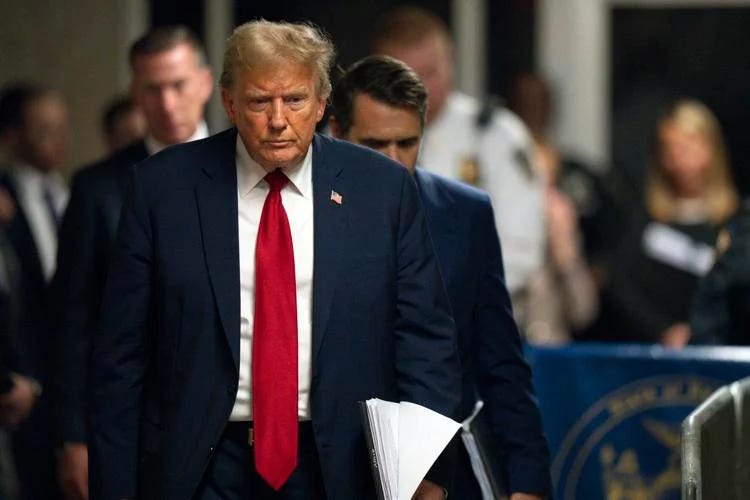
For the past 21 days, Donald J. Trump has been on trial in Manhattan, New York, after being indicted on charges that he falsified business records in order to cover up a damaging story about an alleged affair, in the days leading up to the 2016 presidential election.
During this trial, the prosecution has presented a detailed account of how Trump allegedly orchestrated payments and falsified financial documents to suppress the story, aiming to avoid a potential scandal that could have affected his chances in the 2016 election.
This trial is significant for American democracy and justice because it underscores the principle that no individual, regardless of their status or former position, is above the law. It reinforces the accountability mechanisms within the justice system, ensuring that even a former president can be held responsible for alleged criminal actions. This trial also serves as a critical test of the impartiality and resilience of the legal system, demonstrating its ability to address potential abuses of power and maintain the integrity of democratic institutions.
Background of the Case
In this case, Donald J. Trump faces charges of falsifying business records in the first degree. The prosecution alleges that he falsified records to conceal payments made to Stormy Daniels, intended to buy her silence about an alleged affair. These actions are claimed to have been taken to prevent the damaging story from affecting his chances in the 2016 presidential election, thereby violating state laws regarding business transparency and election integrity.

The Prosecution’s Case
Key elements of the prosecution’s case include evidence and testimonies outlining the $130,000 payment made to Stormy Daniels, facilitated through Trump’s then-attorney Michael Cohen.
They present financial documents and ledgers allegedly showing how the payment was falsely recorded as legal expenses within the Trump Organization.
Additionally, testimonies from witnesses, including Cohen and other insiders, assert that the motive behind the payment and falsification of records was to protect Trump’s electoral prospects by keeping the affair secret.
The Defense’s Case
Key elements of the defense’s case include the argument that Trump did not have the criminal intent required for the charges, claiming that any payments made to Stormy Daniels were intended to protect his family and personal reputation, not to influence the election.
The defense scrutinizes the credibility of key prosecution witnesses, particularly Michael Cohen, highlighting his past legal troubles and motivations for testifying against Trump, and arguing that Cohen’s testimony is unreliable and self-serving.
They also argue that the payments themselves were not illegal and that classifying them as legal expenses was a legitimate business decision, contending that no crime was committed in the process of making and recording these payments.
Additionally, the defense suggests that the prosecution is politically motivated, aiming to undermine Trump’s political career and damage his reputation.
Finally, they emphasize the absence of direct evidence linking Trump to the falsification of business records, arguing that there is insufficient proof that Trump personally directed or was aware of the specific accounting entries in question.
The Jury Deliberation Process
Today, both sides were given as much time as they needed to present their closing arguments to the jury. In New York, the defense is required to deliver closing remarks first, followed by the prosecution.
The jury will return tomorrow to receive instructions from the judge regarding their role in the process of determining facts, before they begin deliberating. Although we can never predict the amount of time it takes for a jury to reach a decision, it’s likely they will return a verdict by Friday.
In a recent interview, former FBI Director and U.S. Attorney for the Southern District of New York, James Comey, was asked to weigh in on this trial, and stated that the Manhattan District Attorney had a much stronger case than he imagined. In his opinion, Comey said “there’s an overwhelming chance of a conviction, a significant but much smaller chance of a hung jury and zero chance of an acquittal.”
Broader Implications for American Democracy
Upholding the rule of law ensures that everyone, including powerful figures, is held accountable for their actions, maintaining the integrity and fairness of the legal system. It reinforces the principle that no one is above the law, which is essential for a functioning democracy.
Given that this is such an unprecedented situation, it is difficult to predict the public response to an eventual verdict. My fear is that this trial will further erode the collective trust in the judicial system and public institutions.
Although, it is my hope and expectation that the American people will remain committed to the principles of justice and accountability and if he is convicted, they will resoundingly reject the convicted felon at the ballot box!
