


Among the hundreds of Democratic campaigns for elected office in 2026, most will follow a familiar formula: mobilize the base, attack extremism, raise money online, and hope the fundamentals break your way.
But what’s happening in Texas is different.
James Talarico — a Democratic state representative — has launched a campaign for the U.S. Senate that is testing something far more ambitious than flipping a seat long held by Republicans. He is attempting to articulate an off-ramp for voters who have fused Christianity with MAGA politics—and he is doing it without contempt, caricature, or apology.
In a state defined by Republican dominance and an entrenched evangelical political infrastructure, that is not a small gamble.

Not Running Against Faith — Running Through It
For years, Democrats have struggled not with whether to speak about religion, but how to do so when confronting Christian nationalist rhetoric. The most common approaches tend to fall into a few predictable patterns:
Engage religious leaders transactionally, treating faith as a constituency to manage rather than a moral framework to inhabit.
Invoke religion sparingly and defensively, careful not to alienate secular voters or trigger culture-war backlash.
Describe faith-driven voters primarily through a political lens — as misinformed, manipulated, or radicalized — rather than as moral actors wrestling with identity and belief.
Rely on constitutional, legal, or technocratic arguments that are correct on the merits but rarely persuasive at the level of values.
Talarico’s distinction lies in his posture: he treats faith as a serious moral vocabulary designed to challenge power rather than sanctify it. He is doing something far more disruptive. It argues that MAGA-style Christian nationalism is not only politically dangerous—it is theologically inconsistent.
Instead of treating faith as a private liability or a cultural landmine, Talarico treats religion as a moral language worth engaging on its own terms. That’s critical in a state where 67% of the population identifies as Christian. Many Texas voters are not primarily ideological; they are identity-driven. Their political loyalties are often downstream of church networks, cultural belonging, and narratives about persecution. When Democrats attack those structures from the outside, they often harden them.
This campaign is trying to open them from the inside.
The “Off-Ramp” Strategy
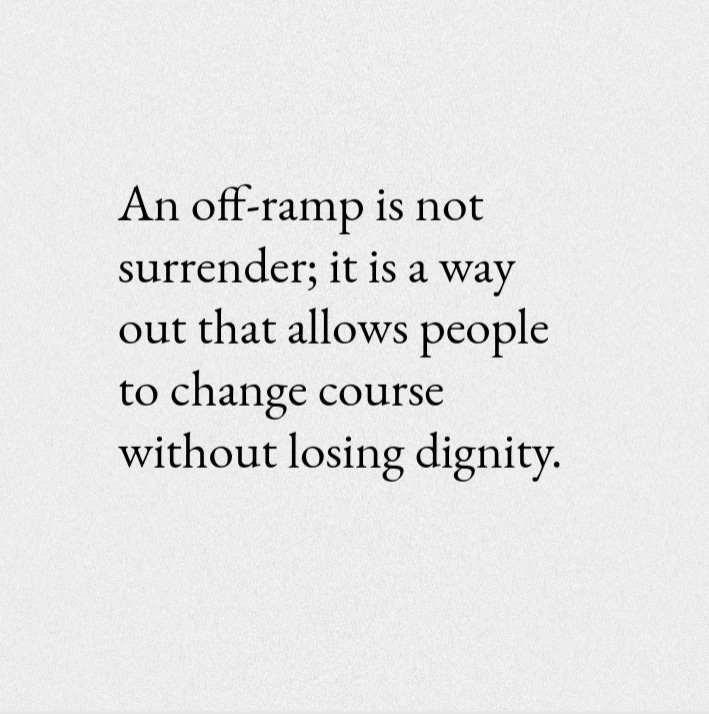
For years, pundits have speculated on how we might emerge from this era of Christian Nationalism and white supremacy. For the first time, a candidate is offering a strategy that actually has a shot. The idea of an off-ramp is crucial. An off-ramp is not surrender; it is not conversion by shame; it is not humiliation. It is a way out that allows people to change course without losing dignity.
The MAGA movement has constructed a powerful psychological ecosystem built on certainty, grievance, and moral absolutism. We know from history that simply telling voters they are wrong rarely dismantles that ecosystem. More often, it reinforces it.
What makes this campaign so analytically interesting is its recognition that persuasion requires moral permission. If you want people to leave a closed identity system, you must give them a story in which they can still see themselves as good. By grounding political arguments in scripture, humility, and service rather than dominance, the campaign reframes the debate from:
“Democrats versus Christians”
to:
“Which vision of Christianity actually reflects love, restraint, and moral seriousness?”
That is not a culture-war escalation. It is narrative jiu-jitsu.

 Tiktok failed to load.
Enable 3rd party cookies or use another browser
A Live Test — Not a Thought Experiment
And this isn’t happening in a vacuum. This argument is being made in the middle of a competitive Democratic primary, with early voting already underway. In other words, this is not a general-election theory being workshopped in elite media spaces—it is a live experiment being judged first by Democratic voters themselves.
That raises the stakes considerably, introducing real tension at the heart of the race.
The Strategic Trade-Off
That tension is this: while the campaign steadily looks like one that could plausibly challenge the Republican nominee statewide, it must first win over Democratic primary voters, who will decide whether they believe this moment calls for persuasion or confrontation.
They will have to choose whether they prefer a more combative, anti-Trump candidate like Jasmine Crockett, whose viral, high-octane style channels Democratic anger and may dominate a primary electorate—but faces a steeper uphill climb in a Texas general election—or a candidate attempting the harder task of expanding the electorate by offering disaffected voters a dignified exit from MAGA politics.
That is not just a stylistic choice. It’s a strategic one.
Texas will not be won by base mobilization alone. Any Democrat hoping to win statewide must either change who votes or change how some voters think about themselves. Confrontation can energize, but persuasion can broaden. This primary will provide valuable insight into which instinct Democratic voters trust more.
Why This Campaign Matters Beyond Texas
Even if this race remains uphill—and Texas politics is unforgiving—the experiment itself is valuable.
American politics is saturated with escalation. What it lacks is a credible theory of de-escalation that does not require moral retreat. This campaign is testing whether moral language, rather than moral scolding, can loosen the grip of authoritarian identity politics.
If the only way out of MAGA politics is humiliation, many voters will never take it.
But if the exit is framed as a return to faith untethered from power to community without cruelty, to moral seriousness without grievance—that is a different story entirely. Whether it succeeds or fails electorally, this campaign is asking one of the most important questions in American politics right now: How do you dismantle an identity movement without destroying the people inside it?
That alone makes this race worth watching.
Aden’s Analysis is a Substack focused on politics, public policy, democracy, and the ideas shaping America’s future. I write for readers who want serious analysis without performative outrage — and who believe persuasion still matters.
Subscribe to receive new posts directly in your inbox.