

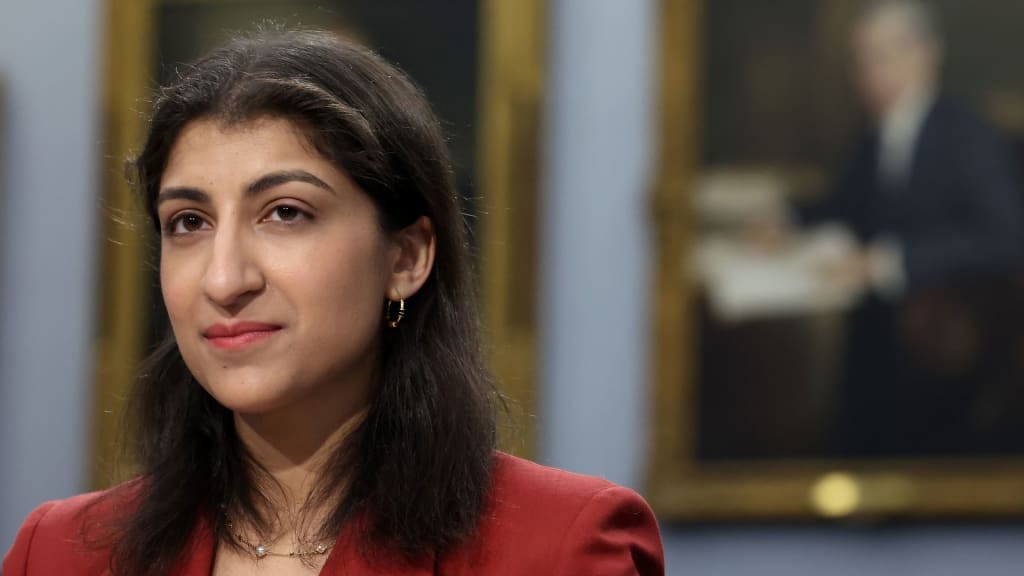
In this edition of In the Arena, I want to spotlight Lina Khan, the fearless Chair of the Federal Trade Commission (FTC), who is redefining the role of antitrust enforcement in the digital age. With unyielding determination and a fierce commitment to protecting American consumers, Khan is taking on some of the toughest challenges of our time—from Big Tech monopolies and deceptive business practices to corporate consolidation.
A Trailblazing Appointment
At just 32 years old, Lina Khan’s appointment as FTC Chair marked a historic moment in U.S. regulatory history. A Columbia Law School professor, Khan was nominated by President Biden shortly after he took office, a move widely seen as a victory for progressives advocating for strong antitrust enforcement. Her nomination was confirmed by the U.S. Senate on June 15, 2021, with a 69-28 vote, making her the youngest FTC Chair in history.
Khan’s ascension to this role wasn’t just about her age; it was a signal of a return to vigorous antitrust enforcement. It was a clear message that the Biden administration intended to confront the growing power of corporate giants, particularly in the technology sector. Her confirmation represented a pivotal shift in the government’s approach to regulating competition and protecting consumers in an increasingly digital economy.
The Mission of the FTC
The Federal Trade Commission Act, under which the FTC operates, empowers the Commission to prevent unfair methods of competition and unfair or deceptive acts or practices in or affecting commerce. The FTC’s mandate includes seeking monetary redress and other relief for conduct injurious to consumers, prescribing rules to prevent unfair or deceptive practices, and conducting investigations into the business practices of entities engaged in commerce. Additionally, the FTC makes reports and legislative recommendations to Congress and the public, aiming to uphold the principles of fair competition and protect consumers from corporate malfeasance.
A Visionary Regulator
Lina Khan’s rise to prominence was fueled by her groundbreaking work as a legal scholar. Her seminal paper, “Amazon’s Antitrust Paradox,” published while she was still a law student, challenged the prevailing antitrust orthodoxy that focused narrowly on consumer prices. Instead, Khan argued that market dominance—especially in digital markets—could harm competition, stifle innovation, and pose significant risks to democracy itself. This paper not only catapulted Khan into the national spotlight but also set the stage for a broader rethinking of antitrust law in the U.S.
Khan’s ideas resonated deeply at a time when public concern about the outsized power of Big Tech was reaching a fever pitch. Her argument that companies like Amazon, Google, and Facebook have amassed too much power, to the detriment of consumers and competitors alike, has fundamentally shifted the national conversation around antitrust enforcement.
Transforming the FTC
As the Chair of the FTC, Khan has wasted no time in setting a bold and ambitious agenda. She has reinvigorated the agency’s role as a vigilant watchdog against corporate misconduct, with a particular focus on tackling anti-competitive behavior in the digital economy. Under her leadership, the FTC has launched major cases against some of the world’s largest corporations, signaling a new era of assertive antitrust enforcement.
Khan’s tenure, however, has not been without controversy. Critics argue that her aggressive approach could stifle innovation and harm the very consumers she aims to protect. But the far greater threat to economic dynamism and democratic values is unchecked corporate power. Khan’s efforts are essential to ensuring that markets remain open, competitive, and fair.
Beyond the FTC: A Broader Movement
Lina Khan’s influence extends far beyond the walls of the FTC. She is at the forefront of a broader movement within the U.S. government to rethink and modernize antitrust enforcement in the face of new technological realities. Her work has inspired a new generation of lawyers, policymakers, and activists who are dedicated to curbing corporate power and promoting economic justice.
Moreover, Khan’s journey from academia to one of the most powerful regulatory positions in the country is a testament to the impact that principled scholarship can have on public policy. Her leadership exemplifies how academic ideas can be translated into real-world actions that protect consumers and promote competition.
Why Lina Khan Matters
Lina Khan is more than just a regulator; she is a reformer. Her work represents a fundamental shift in how we think about the economy and the role of government in ensuring that markets serve the public good. In an era of increasing inequality and concentrated corporate power, Khan’s efforts to rein in monopolies and promote competition are more crucial than ever.
Her leadership at the FTC reminds us that public service is about challenging the status quo, rethinking established norms, and working tirelessly to build a better future. Lina Khan is in the arena, fighting for a more just and equitable economy, and her work will have lasting implications for generations to come.
Khan’s Vision in Her Own Words
Reflecting on her career and vision for the FTC, Lina Khan said at her nomination hearing:
For the last decade, I have focused on studying and investigating markets across our economy and examining the laws that enable honest and fair competition. I first started this work as a journalist and policy analyst, where my job was to document the state of competition across industries and to uncover the abusive business practices that excessive market concentration can enable. I spent years studying markets ranging from chicken farming and airlines to aluminum and book publishing, and learning from entrepreneurs and small businesses about the obstacles that they face. This work taught me the importance of fair competition, and the critical role that the antitrust laws play in encouraging business dynamism and promoting widespread prosperity.
I have built on this work as a legal scholar, where my focus has been to examine the history of America’s antimonopoly laws. This history reveals our long tradition of safeguarding core liberties through promoting competitive markets, and the wide arsenal of tools we have used to protect our economy and our democracy from unchecked monopoly power. Studying this tradition lets us mine our past for lessons we can apply when navigating challenges today.
I have also had the chance to work on competition issues through government service, first at the Federal Trade Commission and, most recently, as counsel to the House Judiciary Committee’s Subcommittee on Antitrust, Commercial, and Administrative Law. While in the House I helped lead a 16-month bipartisan investigation into digital markets, a top-to-bottom empirical review of how these markets are functioning. Pursuing this investigation underscored the important work that enforcers and lawmakers must do to ensure that longstanding laws are keeping pace with new technologies and reflecting current business realities.
Congress created the Federal Trade Commission to serve as a key guardian of fair competition and to protect consumers, workers, and honest businesses from unfair and deceptive trade practices. If confirmed, I look forward to working with my fellow Commissioners, the career staff, this Committee, and the broader public to pursue the agency’s mission with vigor and a deep commitment to serving the American public."
Lina Khan’s bold vision and unwavering commitment to fair competition are reshaping the landscape of antitrust enforcement in the U.S. Her work is not just about regulating markets—it’s about ensuring that they serve the interests of all Americans. As we watch her take on some of the most powerful corporations in the world, it’s clear that Lina Khan is a force to be reckoned with, and her impact on our economy will be felt for years to come.
The Billionaire Dilemma: Pressure to Fire Lina Khan
As Vice President Kamala Harris gears up for the final stretch of her presidential campaign, there are already signs of the immense pressure she will face from some of her high-profile supporters. Recently, one of Harris’s billionaire backers [Reid Hoffman] has reportedly urged her to dismiss Lina Khan as Chair of the Federal Trade Commission. This request raises significant concerns about the influence of powerful donors over our democratic institutions, especially when it comes to the regulation of corporate power.
Khan’s work at the FTC has undoubtedly ruffled feathers in the upper echelons of corporate America. Her aggressive stance against monopolistic practices, particularly in the tech industry, has made her a target for those who benefit from maintaining the status quo. The call for her removal by a wealthy campaign supporter is a stark reminder of the ongoing battle between the public interest and the influence of corporate money in politics.
Why This Matters for Voters
As voters, it is crucial that we hold our leaders accountable to the promises they make and the principles they stand for. Vice President Harris has an opportunity to show her commitment to the American people by refusing to bow to pressure from billionaire donors seeking to undermine the FTC’s efforts. It is essential that Harris unequivocally commit to retaining Lina Khan as FTC Chair and to continuing the fight for fair competition and consumer protection.
This situation underscores the importance of vigilance among voters. As the campaign season heats up, we must demand transparency and integrity from our candidates, ensuring that they prioritize the needs of the many over the interests of the few. Lina Khan’s position is not just about one regulator; it’s about safeguarding the principles of fairness and competition that are vital to our democracy.

A Call to Action
As Harris makes her case to the American people, we must make it clear that retaining Lina Khan and supporting strong antitrust enforcement is non-negotiable. The integrity of our markets and the protection of consumers depend on it. We must ensure that Vice President Harris stands firm in her commitment to these values and resists any attempts to compromise them for the sake of campaign contributions.